We’re going free today, because it’s Told By’s version of Christmas - the launch date of the Digital News Report from the Reuters Institute for the Study of Journalism.
The reason people in news media take this report so seriously is because it’s the most detailed global survey we have documenting changes in journalism and the information ecosystem. On a personal note, I’ve found it often identifies trends before the rest of the industry spots or validates them. In 2021, their report was one of the first pieces of academic literature to cite my work, at a time when I was still struggling to persuade colleagues at the BBC why the organisation needed to be creating vertical video.
The biggest finding you'll hear about this year is that, for the first time, social media and video network consumption is now ahead of all other news sources. This should come as a surprise to absolutely, er, no one who pays attention to online trends - so I'm going to go into some detail in this newsletter about key headlines, what does surprise me, and what insights I'll personally be drawing to tell my clients.
—
- For those of you still struggling to persuade your organisation about the merits of video, 77% of people globally consume online news every week. Given all that growth is happening on third party platforms, this doesn’t only mean you need to be making video - you need to be making video that performs well on those platforms. We’re talking algorithm-ready, community-rallying video.
- You are leaving out young people if video isn't a priority product - more than 52% of 18-24 year olds in the survey treat social media, video networks and AI chatbots as their main way of getting news. When it came to following the war in Iran, social media and video were the preferred way of following the conflict for under 35s - in fact, they were twice as likely to say this as over 35s.
- Don't condescend AI chatbot users - the report found they tend to be digitally sophisticated and intensely follow the news, more likely to seek information out than receive it passively.
- The market where you live might be hiding the truth about video from you. In the UK and US, for example, use of TikTok as a news source is fast growing but low compared to other markets, like Malaysia or Kenya. I promise you we are headed that way too - we're just lethargic because we have strong traditional news brands. In fact, the UK finally switched this year to watching more online news video than TV - basically everywhere else did this years earlier.
- 27% of global audiences consume news from "news creators", but this is considered complimentary rather than substitutive - so it doesn't mean they're not consuming news from other, traditional outlets too. What is likely is that the portion of global audiences who consume news from any kind of creator incidentally is likely to be a lot higher. The one flaw of this report is that it doesn't capture incidental creator news consumption, which really is the challenge facing institutions and newsrooms in my opinion.
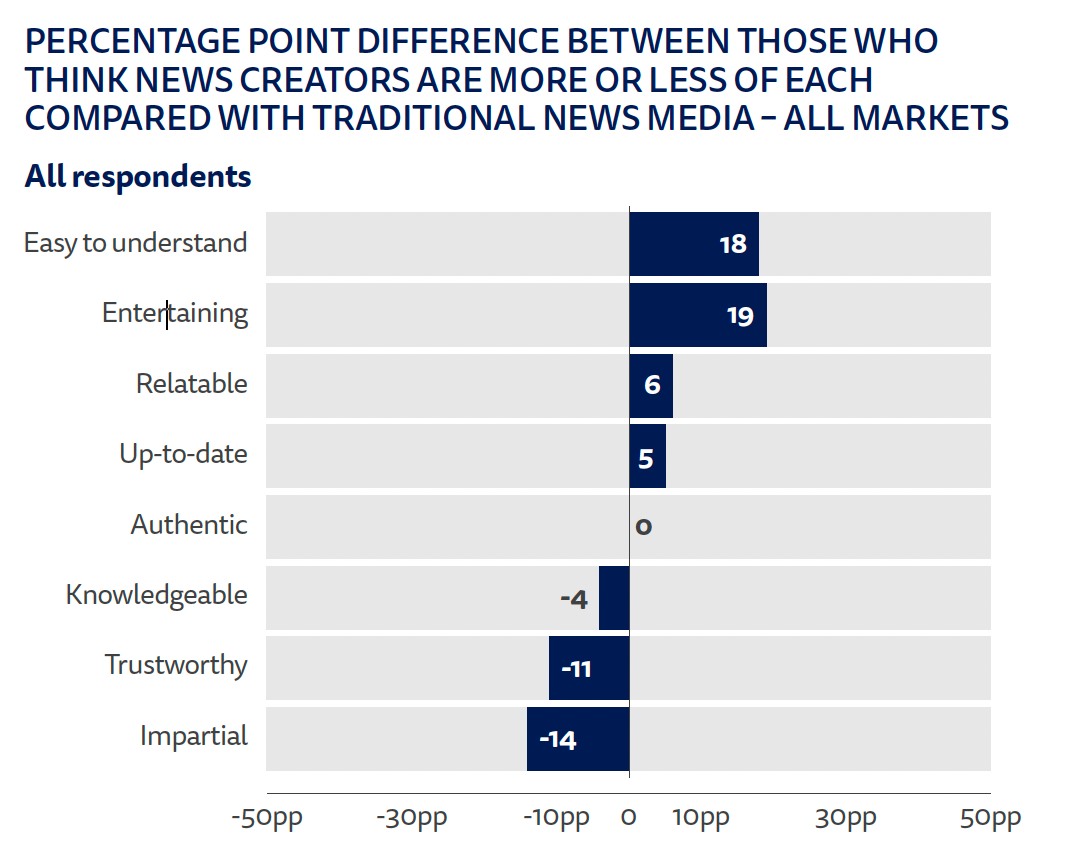
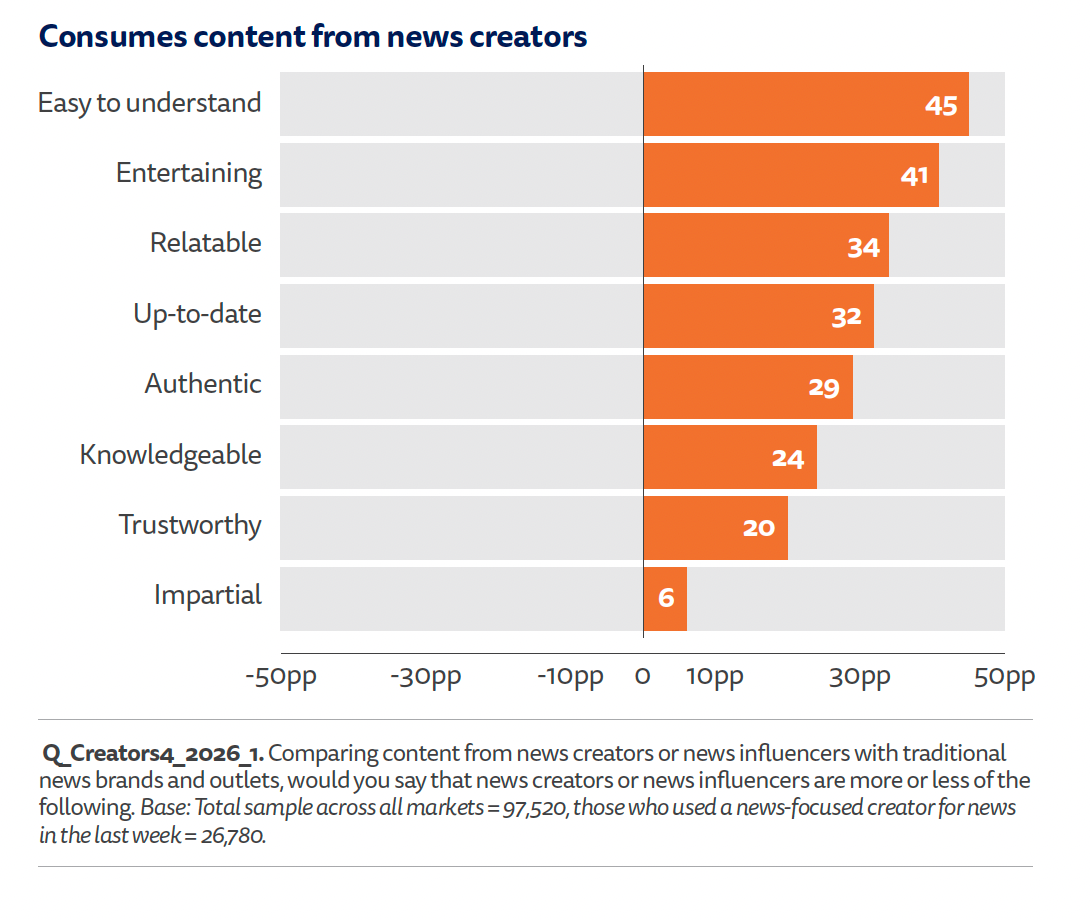
- News creators are performing well because of how easy it is to understand them and how entertaining they are. Social media platforms are ultimately advertising platforms built for entertainment, not news, so the second point isn't surprising. But the first point is an important reminder that traditional outlets all too often assume knowledge and speak down to people. Also - newsrooms bang on about impartiality, and this chart is a reminder that while it might be where creators perform the worst, it sort of seems...a lot of their audience don't care? The premium applied on clarity for many appears to overtake a need for impartiality.
- We have a new and intriguing mapping of the creator ecosystem: the politically polarised, critical voices, youthful changemakers and limited/hybrid ecosystems. Your country likely fits one of these segments - the UK is dominated by legacy media voices who've become creator journalists (hello! it's me!) and so it's a limited/hybrid ecosystem because they seem to be the only people who can get famous online. Weird, isn't it? Why do we have way fewer homegrown creators than the US? The report makes the point that markets like the UK end up having to 'import' creators from elsewhere into our diets because of it. If you're British, consider how many 'news creators' are actually American.
Remember that I've got a plethora of resources for organisations to start using if you're yet to catch up with the vertical video hype. Hundreds of users around the world use my award-winning video scriptwriting and teleprompter app Sophiana; thousands have done my Skillshare training which teaches you the A to Z of how to ideate, script, film and publish video on places like Instagram and TikTok - sign up here to get a free month on the platform.
And I've got my in person workshops that have been taken by everyone from newsrooms and intergovernmental agencies to cosmetics companies. Orgs have seen their average video views skyrocket because of it, and former clients have been able to use the impact they've generated to get extra budget signed off for their social media (!). Paid subscribers to this newsletter get 20% off those workshops, plus the chance to beta test my AI-enabled tools...so what are you waiting for?
In other news
You can re-order your grid now on Instagram. Word on the street is creators are going to start doing this to hide under-performing or audience-alienating brand deals they take on. This might complicate how you work out creators' average engagement rate, so watch out. For the time being, I'm not remotely interested in re-ordering my grid, but that's probably because I'm in the news/information space - I...like my grid being chronological? For now...
Has a news story changed after you've already filmed the content? This is why I always fact-check before publishing - when I'd written the script, FIFA hadn't done anything to respond to a developing viral reaction to some bad decisions they'd made. I filmed the script, edited it, was about to upload and did my final fact-check, as I always do. On the way to [REDACTED], I learned that FIFA had seen the error of their ways and made an excellent decision, changing the original outcome I'd filmed for my video. So - I simply filmed and edited a new video into the original, cobbling it altogether again on the Tube with my laptop out. If you're wondering what the hell I'm on about, my video is here, and it has gone viral nearly everywhere I've published it.
Video mastermind Hank Green has launched a podcast that's audio-only, despite practically every other podcast this year launching as a video show (my own included). He explains why in this YouTube video. TLDR: he doesn't want to bend to the incentives forced by video shows. It's also going to be ad-free to start with. These are the decisions that only the mega powerful top creator class can make, of which Hank is a member. For us plebs - keep filming, and keep clipping. In fact, speaking of clipping...
Did you see Spotify introduce clipping powers for listeners? "With clips, listeners can now capture, revisit, and share the exact moments from podcasts that resonate most, without having to search through an entire episode to find them." Users will be able to send it "directly to friends via Spotify Messages or any supported platform", and "all clips are saved in Your Library, ready to revisit or add to a podcast playlist whenever you want." I don't understand if it actually downloads a clip into people's photo libraries off app or not. If it does, I'm not sure I'd be happy people doing this to my show! But maybe it doesn't. And is this going to turn audiences into clippers and clip-viewers rather than listeners? Curious to know what the audio nerds amongst you think...
This editing party will give you major FOMO. These editors had 40 minutes to edit a sizzle reel out of 16 hours of footage, whilst a party happened around them. I mean...I'd love to do this for vertical video. New workshop facilitation, anyone?
And I've got a pretty special announcement to make next week. It's the biggest opportunity I've had in years, and one that wouldn't be happening without all the work that's gone into my vertical video and building an online community for my niche within the journalism and language space. The collaborator is my biggest yet...so...want to hear more? Then you better subscribe...